
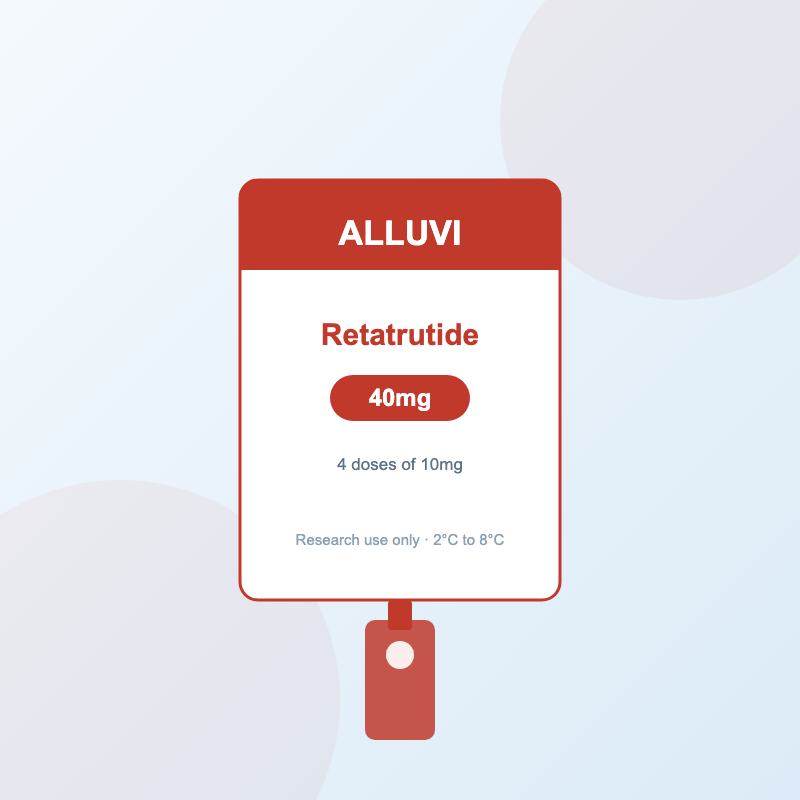
Alluvi Retatrutide 40mg (4 x 10mg Doses)
£100.00
Alluvi Retatrutide 40mg – research-grade triple-agonist peptide (GLP-1, GIP, Glucagon). 40mg total active compound supplied as 4 doses of 10mg. Target pathways: GLP-1, GIP, and Glucagon receptors. Store at 2°C to 8°C. For laboratory and scientific research use only.
50 in stock
Description
Alluvi Retatrutide is a research-grade triple-agonist peptide formulation examined for metabolic pathway interaction and endocrine signaling behaviour in controlled laboratory settings.
Retatrutide has become an important focus within peptide research because it is studied in relation to GLP-1, GIP, and glucagon receptor pathways. This triple pathway interest makes Retatrutide highly relevant to laboratory studies involving receptor pathway comparison, metabolic signalling, glucose response models, and energy balance research.
Alluvi Healthcare provides this compound in precisely measured, highly purified formats designed for structured laboratory assessment.
How Does Retatrutide Work? (Mechanism of Action)
Retatrutide acts on GIP, GLP-1 and glucagon receptors. It has a triple-receptor mechanism, which is different from semaglutide (which selectively targets GLP-1) and tirzepatide (which has both GIP and GLP-1 receptor agonism). Because three receptor systems are involved, retatrutide is frequently referred to as a triple receptor agonist or simply a triple agonist.
Each pathway serves a distinct function in metabolic physiology:
- GLP-1 (Glucagon-Like Peptide-1): Active in processes involving glucose-dependent insulin secretion, appetite-related signalling and gastric emptying.
- GIP (Glucose-Dependent Insulinotropic Polypeptide): A nutrient-dependent incretin hormone that is linked to insulin signalling.
- Glucagon: Plays an important role in glucose homeostasis and energy metabolism.
Scientists are actively studying whether this triple receptor action has a different metabolic effect than agents that activate fewer receptors.
Phase 2 Clinical Trial Context
Much of the wider scientific interest has focused on research about obesity and body weight changes. In a Phase 2 clinical trial involving 338 adult participants with a history of obesity (or overweight) and at least one weight-related condition, researchers studied a number of combinations of retatrutide over 48 weeks.
- The participants on the regimen studied at 48 weeks lost an average of 24.2% of their body weight, while the placebo group lost an average of 2.1%.
- Please Note: The results reported herein are those of controlled clinical trials with specific doses. A total stated pen or vial content of 40mg is not to be construed as a 40mg clinical dose.
The Alluvi Healthcare Standard
When procuring research peptides, quality control and structural integrity are paramount. Alluvi Healthcare guarantees:
- High-Quality Ingredients: Manufactured under stringent standards to ensure optimal peptide stability.
- Lab Tested for Purity: Rigorous batch testing guarantees the highest purity for accurate, uncontaminated laboratory results.
- Cold Chain Delivered: Peptides are sensitive to temperature fluctuations. We ensure safe, temperature-controlled delivery across the UK to maintain product efficacy.
- Trusted by Professionals: The preferred choice for laboratories, research organisations, and clinical researchers requiring reliable, reproducible materials.
Important Research Disclaimer
Strictly for Laboratory and Scientific Research Use Only.
Alluvi Retatrutide is not intended for human consumption, veterinary use, self-administration, clinical use, treatment, diagnosis, prevention, cosmetic use, supplement use, body composition use, wellness use, weight-loss use or any form of personal use.
We do not provide dosing guidance, preparation instructions, administration guidance, injection advice, clinical-use guidance or personal-use support. Customers must ensure that all products are handled responsibly within appropriate laboratory and scientific research environments.
Frequently Asked Questions
What is the difference between Retatrutide, Tirzepatide, and Semaglutide?
The primary difference lies in the number of hormone receptors each compound targets. Semaglutide is a single agonist targeting only the GLP-1 receptor. Tirzepatide is a dual agonist targeting both GLP-1 and GIP receptors. Retatrutide is a triple agonist, targeting GLP-1, GIP, and the Glucagon (GCG) receptor.
In comparative research, the addition of the third receptor (glucagon) is being studied for its ability to increase baseline energy expenditure beyond what single or dual agonists achieve.
What is a triple-agonist peptide?
A triple-agonist peptide is an engineered compound designed to simultaneously bind to and activate three distinct metabolic pathways. In the case of Retatrutide, these are the Glucagon-Like Peptide-1 (GLP-1), Glucose-Dependent Insulinotropic Polypeptide (GIP), and Glucagon receptors. This multi-target approach is currently a major focus in cardiometabolic and endocrine research.
How does the Glucagon receptor (GCG) activation work in Retatrutide?
While GLP-1 and GIP primarily slow gastric emptying and regulate insulin and appetite, the addition of glucagon receptor agonism actively promotes thermogenesis (energy expenditure) and lipolysis (the breakdown of fats) in the liver and adipose tissue. This unique mechanism is why Retatrutide is often studied for its impact on hepatic fat reduction and total metabolic rate.
What were the results of the Retatrutide Phase 2 clinical trials?
In published Phase 2 clinical trials involving 338 adults with obesity or overweight conditions, participants taking the highest studied dose (12mg) of Retatrutide experienced an average body weight reduction of 24.2% over 48 weeks. By comparison, the placebo group saw a 2.1% reduction. These trials also noted significant secondary improvements in blood pressure, triglycerides, and non-HDL cholesterol.
What are the most common side effects observed in Retatrutide studies?
Data from Phase 2 and Phase 3 clinical trials indicate that the most common side effects are gastrointestinal, similar to other GLP-1 medications. These include nausea, diarrhoea, vomiting, and constipation, which typically peak during the initial dose-escalation phases. Trial data also noted temporary increases in resting heart rate that generally declined as the studies progressed.
What is dysesthesia, and why is it linked to Retatrutide?
Dysesthesia is an altered skin sensation often described as tingling, burning, or heightened sensitivity. During clinical trials, roughly 9% to 20% of patients reported mild-to-moderate dysesthesia, particularly at higher doses. Researchers believe this specific skin sensitivity is linked to how the peptide interacts with glucagon receptors. In clinical settings, it was generally reported to resolve on its own as treatment continued.
Related products


*For research purposes only. Store in a refrigerator (2°C to 8°C). For subcutaneous injection only. Read package leaflet before use.
